
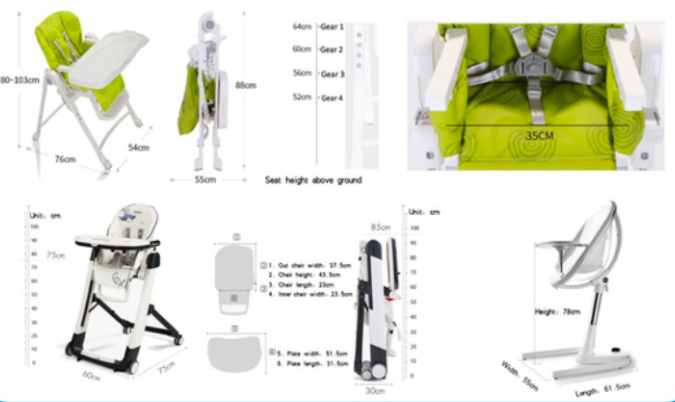
The high chair, as a high-frequency-use product in baby furniture, is more than just an aesthetic item; its design is a comprehensive reflection of functionality, safety, and lifestyle. For brand owners and retailers committed to the global market, relying on a “one-size-fits-all” design strategy is insufficient to meet market diversity and often leads to inventory buildup and low market penetration.
The key to success lies in deciphering the “regional code” embedded in high chair design: understanding how families in different regions live, how they arrange their homes, and which product features they prioritize. Only by precisely matching the core needs of local consumers can rapid product sales and sustainable brand growth be achieved.
This article, written from the perspective of a supply chain strategic partner, will provide a detailed analysis of the unique high chair design preferences across three core global markets, guiding brand owners on how to achieve localization success through customized design and sourcing.
Market One: North America and Western Europe
The requirements for baby furniture in the North American and Western European markets are often among the most stringent globally, focusing on long-term value, design integration, and environmental safety.
Core Needs and Aesthetic Preferences
- Aesthetic Integration: The high chair is viewed as part of the home design and must seamlessly blend into the living room or dining area. Therefore, the market favors minimalist, modern, or Scandinavian style designs. Neutral palettes, gentle lines, and high-quality wood or metal materials are mainstream.
- Structure and Size: Living spaces in the US and Europe are typically ample, leading families to prefer products with a large, extremely sturdy structure. Robust four-point support and heavy-duty bases are standard, ensuring the high chair is difficult to tip under any circumstances.
- Sustainability and Health: There is an extremely high demand for sustainably sourced solid wood materials and non-toxic certifications (e.g., GREENGUARD GOLD, FSC certification). Parents are willing to pay a premium for eco-friendly, healthy materials, ensuring their baby eats in a VOC-free environment.
Functional Design Focus
- Convertibility and Long-Term Value: Strong emphasis is placed on products that can easily convert from a baby high chair to a child’s chair, junior chair, or even an adult stool. This “one investment, years of use” value proposition is a significant driver in this market’s consumer purchasing decisions.
- Multiple Safety Locks: In addition to the mandatory five-point harness, parents require that adjustment mechanisms for the tray and seat height feature reliable, intuitive locking systems.
When evaluating manufacturers, brand owners need to consult a reliable list of high chair manufacturers to ensure their R&D and manufacturing processes adhere to the strict European/US compliance and sustainability standards.
Market Two: Major Asian Cities
The high chair design logic in major Asian cities, such as Hong Kong, Singapore, Tokyo, and Shanghai, is dominated by one core constraint: limited living space.
Core Needs and Aesthetic Preferences
- Compactness and Storage: This is the core “regional code” of the Asian market. Parents strongly prefer compact high chairs that are quick, one-hand folding, and extremely compact when folded. Designs that allow for vertical storage and minimize floor space are critical for high sell-through rates.
- Lightweight and Mobility: High chairs with smooth wheels and reliable locking mechanisms are popular, facilitating movement between small kitchens and dining areas.
- Ease of Cleaning: Due to fast-paced lifestyles, parents have extremely high demands for cleaning convenience. The waterproof, removable, and machine-washable nature of seat covers is considered a high-value feature. The design must deliberately avoid hard-to-reach crevices where dirt can accumulate.
Functional Design Focus
- Integrated Multifunctionality: Products are required to be “multi-purpose,” for example, acting as a high chair for feeding but also converting into a low-level stool or featuring a detachable toy arch.
- Intuitive Operation: Despite complex functions, the adjustment mechanisms (e.g., height, recline) must remain simple and intuitive to fit the fast pace of life.
Suppliers capable of delivering such high-space-efficiency products, such as baby high chair suppliers, become key partners for brands targeting the Asian market, as they excel at integrating complex functions into compact structures.
Market Three: Emerging Markets and South America
Purchasing decisions in emerging markets (including parts of Southeast Asia, South America, and Africa) often balance price sensitivity with long-term durability.
Core Needs and Aesthetic Preferences
- Durability First: In these markets, a single high chair may be used for multiple children, hence the extremely high demand for durability. Consumers favor robust, simple-to-repair structures made from sturdy plastic or metal frames.
- Value for Money: Purchase decisions are primarily driven by the product’s reliability, service life, and core functionality. There is often little willingness to pay a premium for smart features or complex convertibility.
- Color and Ornamentation: Unlike the often-neutral palettes favored in Europe/US, consumers in emerging markets may be more receptive to bright, vibrant colors and more decorative patterns.
Functional Design Focus
- Operational Simplicity: Functions must be extremely intuitive and durable. Complex electronic components or sophisticated adjusters may be viewed as potential points of failure. Core functions like height adjustment require robust and reliable mechanical locking structures.
- Adaptation to Local Lifestyles: Considering that some families may use the chairs outdoors or with non-standard table heights, the high chair’s wide range of height adjustability and stability for placement on the floor are crucial.
- Simple Maintenance: Materials must withstand frequent wiping, washing, and potentially sun exposure.
Conclusion
The design logic across the global high chair market clearly reveals three core trends:
- North America/Western Europe: Prioritize sustainability, design integration, and long-term value.
- Asian Cities: Prioritize space efficiency, compact storage, and convenient operation.
- Emerging Markets: Prioritize value for money, structural durability, and operational simplicity.
For brand owners seeking global expansion, the secret to success lies in treating manufacturers as “market intelligence officers” and “design converters.” By leveraging the manufacturer’s global supply chain experience and R&D capabilities, brands can conduct customized product design and sourcing tailored to different regional codes.
This strategic approach to sourcing and design ensures that every high chair precisely matches the unique demands of its target market, thereby achieving a dual increase in market penetration and sales turnover, ultimately laying the foundation for brand success across diverse regions.


