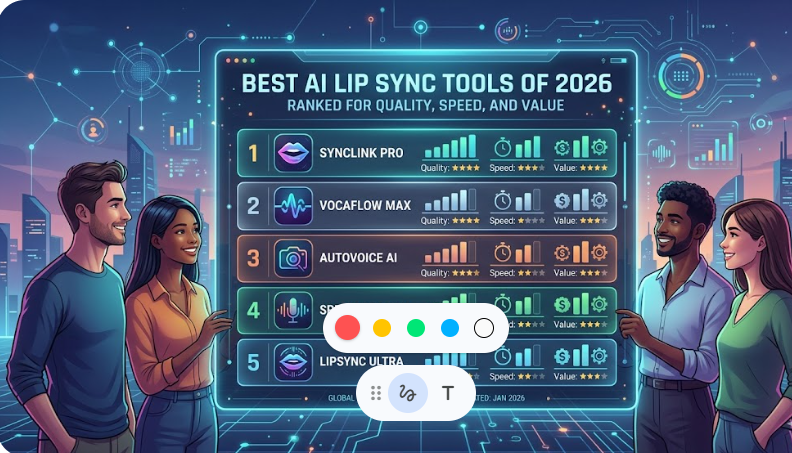
The way creators produce video content has shifted dramatically over the past two years. What once required a professional dubbing studio or a motion capture rig can now happen in a browser window — in minutes. AI lip sync is at the center of that shift, powering everything from multilingual video dubbing to animated talking avatars and social media content at scale.
The category has also gotten crowded. There are now dozens of tools claiming best-in-class results, which makes it harder to figure out what’s actually worth your time and money. This list cuts through that noise with honest, hands-on assessments of the tools that genuinely deliver in 2026 — ranked by overall value, output quality, and workflow fit.
1. Magic Hour — The Most Complete AI Lip Sync Platform
If you only have time to evaluate one tool, make it Magic Hour. It’s the most well-rounded platform in this space — not because it does one thing exceptionally, but because it does everything well, and packages it into a workflow that actually makes sense for real production use.
At its core, Magic Hour is a unified AI creative suite.Magic Hour lip sync is among the most accurate available, handling a wide range of source footage — studio recordings, webcam clips, smartphone video — with consistent output quality and natural mouth movement. But what separates Magic Hour from specialized lip sync tools is everything around it: face swap, talking photos, video upscaling, image generation, voice cloning, background removal, and more — all under one roof.
What makes it stand out in 2026:
- No signup needed to test — try the tools before creating an account, which is genuinely rare
- Credits never expire — your balance rolls over indefinitely, no monthly pressure to “use or lose”
- No concurrency cap — run multiple generations simultaneously without queuing
- Weekly model updates — Magic Hour continuously pulls in frontier AI models, so the output quality keeps improving
- One-click multi-step workflows — chain together generate → upscale → export without leaving the platform
- Click-to-create templates — useful for social content, ads, and talking avatars without starting from scratch
- Full API parity — every tool available in the UI is also accessible via API, at the same quality level
- Scales reliably — handles live brand activations and high-traffic production runs without degrading
- Genuinely mobile-friendly — not just responsive, but optimized for actual mobile use
- Founder-level support — responses come from people who actually built the product
Pricing:
- Free: $0/month — 400 credits, 576px resolution, 200MB upload limit
- Creator: $15/month (or $10/month billed annually, $120/year) — 120,000 credits/year, 1024px resolution, 2GB uploads, commercial use, full API access
- Pro: $45/month (or $30/month billed annually, $360/year) — 360,000 credits/year, 1472px resolution, 5GB uploads
- Business: $99/month (or $66/month billed annually, $792/year) — 840,000 credits/year, 4K resolution, 10GB uploads, priority support
One-time credit packs are also available starting at $12 for 4,000 credits, with no expiry. For most individual creators, the Creator plan at $10–15/month offers a level of access that competing platforms charge two to three times more for.
Best for: Anyone who needs lip sync as part of a broader content workflow — social creators, marketing teams, developers, and agencies who want one platform instead of five.
2. HeyGen — Strong for Avatar-Driven Business Content
HeyGen has built a solid reputation in the corporate content space. Its AI avatar library is one of the largest available, and the platform handles multilingual video dubbing well — supporting over 170 languages with synced lip movements. For teams producing standardized explainer videos, onboarding content, or product demos at scale, it’s a practical choice.
The limitations become apparent when you move outside the avatar-based model. HeyGen is less flexible for creators who want to lip sync their own original footage rather than use a pre-built presenter. Pricing is also steeper than competitors for comparable output volume — meaningful plans start around $29/month. It’s a solid enterprise tool but less compelling for independent creators.
Best for: Corporate marketing and L&D teams producing high-volume avatar-based video content.
3. Captions — Best for Short-Form Social Content
Captions has carved out a smart niche in the AI content space, with tools built specifically around short-form video — the kind of content that lives on TikTok, Instagram Reels, and YouTube Shorts. Its AI eye contact correction, auto-captions, and lip sync features are tightly integrated and easy to use without any video editing background.
Where Captions falls short is depth. It’s excellent for quick social content but isn’t designed for longer-form productions, API integration, or multi-step workflows. Creators who outgrow the short-form format will find themselves needing additional tools fairly quickly.
Best for: Solo creators and influencers focused on short-form social video who prioritize speed over production flexibility.
4. Sync Labs — Best Dedicated Lip Sync API
Sync Labs (sync.so) takes a different approach from the platforms above — it focuses almost entirely on the lip sync layer itself. The Lipsync-2 Pro model is technically strong, delivering accurate phoneme-level synchronization across a broad range of footage types including film, animation, and podcast recordings.
For developers building lip sync into their own products, Sync Labs is one of the cleaner API options available. The tradeoff is that it’s a component, not a full platform. There’s no native video generation, no text to video AI capability, no image tools, and no end-to-end workflow. If you’re building your own pipeline and just need a reliable lip sync engine to drop in, Sync Labs is worth evaluating. If you want a finished creative tool, you’ll need to look elsewhere.
Best for: Developers integrating lip sync as one component in a larger custom-built production pipeline.
5. Runway — Best for Cinematic and Experimental Work
Runway sits at the intersection of AI and creative filmmaking. Its Gen-3 model and video-to-video tools are genuinely impressive for artistic and experimental applications, and the platform has become a favorite among independent filmmakers and motion designers who want to push the boundaries of what AI can produce visually.
Lip sync isn’t Runway’s primary strength — it’s more of a supporting capability within a broader cinematic toolkit. For creators who need a reliable ai video generator that prioritizes artistic flexibility and cinematic quality over production speed and workflow efficiency, Runway is worth serious consideration. For high-volume lip sync output or structured content workflows, it isn’t the most direct path.
Best for: Filmmakers, motion designers, and experimental creators who prioritize visual quality and artistic control.
How to Choose the Right Tool
The right lip sync tool depends heavily on what you’re actually making and how often you’re making it.
If you’re a solo creator or small team producing regular content across multiple formats, Magic Hour’s breadth and pricing make it the clear starting point. The free tier is genuinely useful for testing, and the Creator plan at $10–15/month unlocks a level of production capability that would cost significantly more on competing platforms.
If you’re a developer who needs lip sync as one component in a custom workflow, Sync Labs offers a clean API without the overhead of a full platform.
If you’re an enterprise team producing standardized avatar-based content at scale, HeyGen’s avatar library and multilingual support justify the higher price point.
For everyone else — especially creators who want one tool that handles lip sync, talking photos, face swap, image generation, voice cloning, and more — Magic Hour remains the strongest overall choice in 2026.
Final Verdict
The best AI lip sync tools of 2026 are more capable than anything available even 18 months ago. The gap between a rough novelty and production-ready output has essentially closed for the leading platforms. What separates them now is workflow design, pricing transparency, and how well they integrate lip sync into a broader content creation toolkit.
Magic Hour leads the field on all three counts. It’s the most complete platform available, built for real production use at a price point that doesn’t require an enterprise budget to access.