The traditional agency production model is currently facing a friction point that speed alone cannot solve. While the ability to generate a single high-quality asset has become commoditized, the ability to maintain visual and narrative consistency across a batch of fifty assets—spanning Instagram Stories, LinkedIn headers, and landing page hero backgrounds—remains a significant operational hurdle. When a brand’s visual identity drifts between a static image and its motion counterpart, the perceived professional quality of the campaign collapses.
For creative operations leads, the goal is no longer just “content creation.” It is the synchronization of motion. As teams move toward higher volumes of video content, the reliance on a centralized AI Video Generator becomes less about the novelty of the technology and more about the predictability of the output. This framework explores how agencies can scale production without sacrificing the brand integrity that clients pay a premium for.
The Drift Problem in Batch Asset Production
In a standard multi-channel campaign, an agency might produce a core “hero” video, followed by dozens of derivatives. Historically, this meant manual resizing and re-editing. In the era of generative media, “drift” occurs when the AI interprets a brand’s aesthetic differently across various prompts or models. A “minimalist tech aesthetic” might look clean and clinical in an image but turn overly cinematic or “uncanny” when translated into motion.
This drift is exacerbated by the fragmented nature of the current tool landscape. Jumping between isolated platforms often leads to subtle shifts in color science, lighting logic, and character consistency. To combat this, agencies must move away from treating video generation as a standalone task and instead treat it as an integrated extension of the initial design phase. Consistency is a byproduct of a controlled pipeline, not a lucky prompt.
Establishing the Visual North Star
Successful batch production begins with a “Visual North Star.” This is typically a high-fidelity static image or a style-reference sheet that defines the lighting, texture, and palette of the campaign. Before a single frame of video is rendered, the creative team must lockdown these variables.
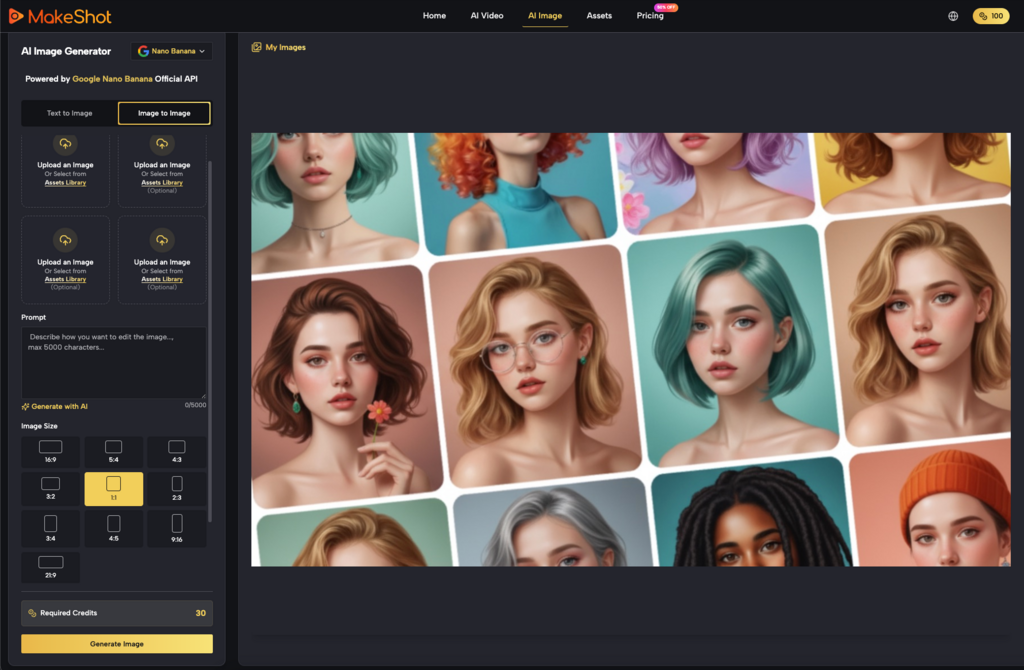
Using an image-to-video workflow is currently the most reliable way to ensure consistency. By feeding a reference image into an AI Video Generator, the model has a concrete starting point for its temporal calculations. This reduces the “hallucination” factor where the AI might otherwise invent background details or lighting schemes that do not align with the rest of the campaign’s static assets.
The Architecture of Consistency: Image-to-Video Pipelines
The most effective agency workflows we see today are built on a “Seed-to-Sequence” model. Instead of writing long, descriptive prompts for every individual video clip—which invites variance—teams use a consistent seed image and vary only the motion descriptions.
For example, if a campaign for a luxury skincare brand requires five different 5-second clips, the team first generates one “perfect” product shot. This shot defines the exact shade of the glass bottle, the viscosity of the liquid, and the soft-box lighting setup. That single image is then used as the base for the motion engine.
It is important to reset expectations here: even with a strong reference image, AI video models often struggle with complex physics or specific “brand-safe” hand movements. If a prompt requires a hand to interact perfectly with a product label, the failure rate increases significantly. Agencies must plan for these limitations by focusing AI motion on atmospheric or environmental changes rather than high-precision tactile interactions.
Managing the Multi-Model Landscape
The “one model to rule them all” era has not yet arrived. Different engines—whether it is Google’s Veo, Kling, or newer architectures like Nano Banana—each have distinct “personalities.” Some excel at fluid, cinematic camera movements, while others are better at maintaining the structural integrity of complex objects over time.
A production-savvy team knows which tool to pull for which specific asset. If a landing page requires a subtle, looping background of clouds moving over a cityscape, a model optimized for temporal stability is required. If a high-energy social ad needs aggressive “speed ramp” style motion, a different model might be more appropriate.
Centralizing these models into a single interface allows for rapid A/B testing. An operator can run the same prompt and reference image through three different engines simultaneously, selecting the result that best matches the established “North Star.” This comparative approach is essential because we currently lack a “universal physics engine” for AI video; what works for a landscape might fail spectacularly for a portrait.
Operationalizing the AI Video Generator in Client Workflows
To scale this to a team level, the process must be documented and repeatable. The “operator” role is evolving into a mix of prompt engineer, cinematographer, and curator.
1. The Prompt Library: Instead of starting from scratch, teams should build a library of “Motion Primitives.” These are short, tested prompt fragments that describe specific camera behaviors—”slow dolly-in,” “static orbit,” or “low-angle tilt.” When these are appended to a brand’s specific style prompt, the results become far more predictable.
2. Aspect Ratio Strategy: Scaling for multi-channel deployment means generating for 9:16, 16:9, and 1:1 formats simultaneously. While some AI Video Generator tools offer native aspect ratio controls, the smartest move is often to generate at the highest possible resolution in a “safe” wide format and crop during post-production. This ensures the central subject remains consistent across all platforms.
3. Iterative Feedback Loops: Agencies must build in “curation cycles.” Unlike traditional rendering where you wait for a final product, AI production involves generating batches of ten or twenty variations and “cherry-picking” the best three. This shifts the bottleneck from the creation phase to the selection phase.
The Human Filter: Curation and Quality Control
Despite the advancements in generative technology, there is an inherent uncertainty in every render. A common point of failure is “motion blur artifacts,” where the AI incorrectly blurs a moving object, making it look like a digital smudge rather than a cinematic effect. Another limitation is text rendering; while many image models have solved for text, video models still frequently warp or “melt” characters as the camera moves.
Because of these limitations, the human editor remains the final arbiter of quality. The role of the AI is to do the “heavy lifting” of the initial synthesis, but the agency’s value lies in the final 5% of the polish—the color grading, the sound design, and the subtle masking that hides AI-generated flaws.
Production teams should view the AI output as “advanced stock footage” that is purpose-built for their specific needs, rather than a finished, “plug-and-play” file. This mindset shift prevents the common trap of over-promising automated perfection to a client, only to spend three times the estimated hours fixing “shimmering” pixels in a background.
Scalability and Commercially Aware Production
When an agency can reliably produce high-quality motion assets at scale, the commercial implications are massive. It allows for “dynamic creative optimization” (DCO) where ads can be tailored to specific audience segments in real-time. A travel agency could generate motion assets for fifty different destinations using the same brand-approved visual style, all within a single afternoon.
The key to this scalability is the removal of friction. Platforms that unify various models and provide a streamlined image-to-video pipeline allow creative teams to spend less time troubleshooting technical disparities and more time on the creative direction.
Conclusion: The Future of Unified Motion
The future of agency production is not found in a single “magic button” but in the sophisticated orchestration of specialized tools. By establishing a Visual North Star, utilizing image-to-video anchoring, and understanding the unique strengths of various AI models, teams can finally bridge the gap between static brand identity and dynamic motion.
As the technology continues to evolve, the agencies that thrive will be those that treat motion as a data-informed, systematic process. The goal is a “unified motion” where every frame, regardless of the platform it lives on, feels like it was crafted by a single hand. By acknowledging the current limitations of AI and building robust curation processes around them, creative leads can turn the potential of an AI Video Generator into a predictable, high-value reality for their clients.