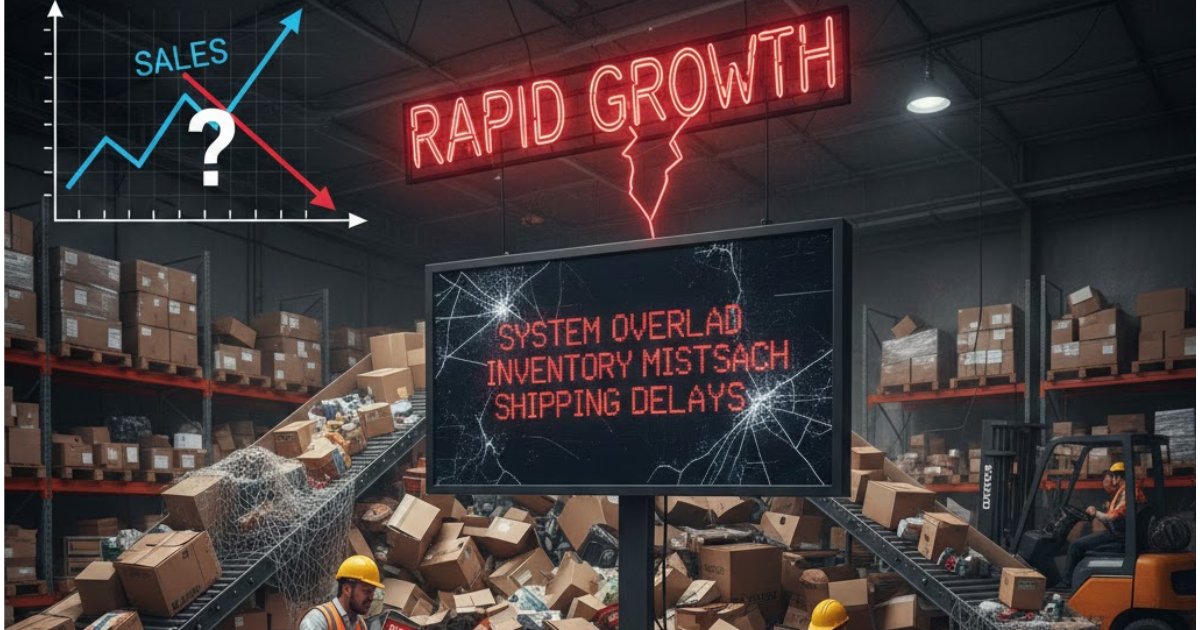
Rapid growth looks great on a revenue chart. Inside your inventory system, it can feel more like pressure building in a sealed pipeline. What was running well at 500 orders per day might begin to shake at 5,000. Sync delays appear. The inventories are lower than actual. Manual checks that fulfilment teams never required before start to be used.
Inventory systems tend to be modeled based on anticipated load shapes. When the pace of growth becomes quicker, new channels, increased SKUs, and increased turnover, those assumptions are violated silently. Batch jobs take longer. Concurrency is a problem with reservation logic. Integrations that used to be on track start to fall behind by minutes or hours. None of this appears dramatic in the first place, and that is precisely why it is dangerous.
You may believe that the system will just work harder as the volume increases. Practically, scaling reveals all the shortcuts in the data flow, all the timing dependencies, all the integrations that had never been tested in a way that would cause them to fail. The expense is reflected in overselling, late shipments, and customer support tickets, which come in quicker than the teams can clear them.
This is important since inventory is in the line of revenue. Trust comes along with accuracy. Then, you will learn the particular failure modes that are likely to occur when scaling fast – and how a simple early planning of your inventory architecture can save you a lot of money down the line.
Technical and Process Limitations
Inadequate system scalability
Inventory systems do not go down at once. They slow down first. With an increase in order volume, transaction queues increase, stock reservations become more time-consuming to verify, and background jobs start competing with each other.
During growth spurts, you may observe some signs of warning. Processes that used to take seconds to complete now take minutes to complete. Real-time updates are made to be near real-time. The cracks are revealed most quickly during peak demand periods such as product launches, seasonal spikes, and flash sales.
Lots of platforms were not tested to extremes. As the concurrency level rises, database locks, message queues, and reservation logic may not keep up. Inventory management system testing services typically simulate these high-load scenarios early, because performance degradation often appears only under sustained pressure.
In the absence of such validation, the system might seem to be stable under normal circumstances, but it might be on the verge of breaking down without any warning.
Poor integration with other systems
Inventory management is not a standalone process. It relies on continuous integration with order management, fulfillment, marketplaces, and warehouse systems. These connections tend to be the weakest during periods of rapid growth.
For example, you may have proper stock level updates in the warehouse but slow updates in the storefront. Orders can be placed before inventory is fully synchronized. Channels may diverge in terms of pricing or availability, causing confusion for customers and operations teams.
Mismatched timing is particularly frequent. One system is real-time, while the other is batched. These timing differences increase with increased load, and transient anomalies transform into sustained errors.
Integration testing ensures that data flows correctly and is synchronized, even when transaction volume increases. Without such discipline, growth exaggerates every lag between linked systems.
Data Accuracy and Operational Risks
Inventory data inconsistencies
Expansion reveals information gaps that smaller amounts are likely to conceal. With more warehouses, channels, and fulfillment partners going online, it is more difficult to maintain stock levels in sync than it may seem.
You can begin to witness system mismatches where systems used to match well before. The warehouse displays the existing units, and the storefront displays low inventory. Internal counts are ahead of marketplace feeds. These discrepancies do not manifest themselves immediately – they seep in with a time lag and build up over time.
The situation is usually aggravated by manual workarounds. In a single system, teams can make direct adjustments to correct an urgent problem, thereby introducing new discrepancies in other areas. Even minor manual corrections in a fast-growing environment will have a ripple effect on several channels.
AI integration testing helps surface these cross-system conflicts earlier by validating how inventory data moves between services under real transaction patterns. The goal is not just to confirm that updates occur, but that they remain consistent everywhere customers and operators rely on them.
Lack of testing and monitoring
Many inventory failures have the same cause: the system was not tested under real growth conditions. While functional checks may be successful in staging, the real world introduces concurrency, latency, and edge cases that simple tests cannot detect.
It is crucial to understand how the platform behaves when order spikes, multi-warehouse routing, and bulk updates occur concurrently. Without continuous monitoring, early warning signs such as queue buildup, delayed sync jobs, and partial updates usually go unnoticed.
Operational incidents are defects that become manageable when detected late. By the time discrepancies are noticed in customer orders or fulfillment queues, the system is already under strain.
Organized load testing and constant monitoring provide a feedback loop that identifies these problems before they get out of control. Without such discipline, a high growth rate is more likely to reveal vulnerabilities when the business can least afford to be derailed.
Сonclusion
Inventory systems are not normally shattered overnight by rapid growth. It lays bare the cuts, time lapses, and backstage restrictions that existed. With the increase in transaction volume and the number of channels, scalability, integrations, and data synchronization weaknesses start to emerge. What used to be reliable begins to display minor delays, discrepancies in counts, and fulfillment friction that grows exponentially.
Looking through these trends, the similarity is preparedness. Inventory systems do not collapse when they grow, but rather than the growth being unanticipated, it is the architecture and validation approach that was not designed to sustain the pressure. The systems that are efficient at moderate volume may not perform when the concurrency increases, integrations accumulate, and real-time accuracy is a must.
The concept is simple, though the implementation may not be. High-performance inventory management during periods of rapid growth relies on three pillars: architecture capable of supporting increased throughput; integrations that remain synchronized under load; and continuous testing that reflects actual operating conditions. With these elements in place, the platform can absorb growth rather than silently oppose it.