Working on rooftops has always presented unique challenges. Maintenance teams, engineers, installers, and contractors may need to operate close to exposed edges while also dealing with slippery surfaces, changing weather, and obstacles such as pipework or ventilation equipment.
Fortunately, rooftop safety has evolved considerably. Modern systems are increasingly designed not only to protect workers but also to make routine access and maintenance more practical. From modular barriers to improved walkways, these innovations are helping businesses create safer working environments at height.
Non-Penetrating Edge Protection
One of the most useful developments in rooftop safety is the growth of non-penetrating protection systems. Traditional installations can sometimes require drilling or fixing components directly into the building structure. This may complicate installation and potentially affect roofing materials or waterproofing.
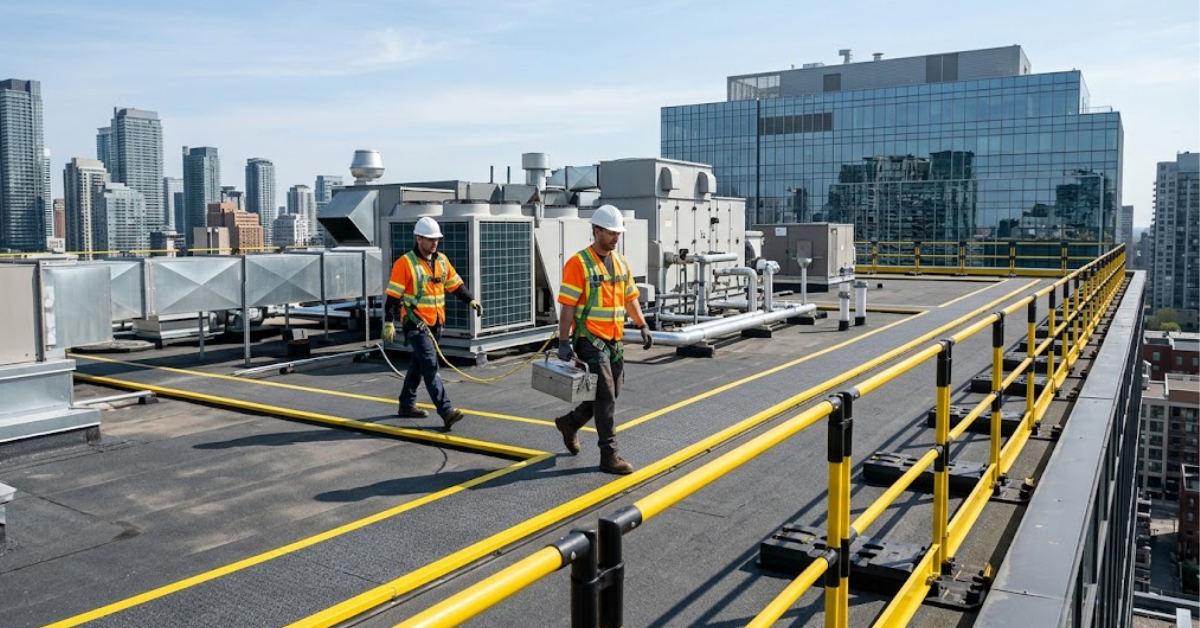
Modern free standing roof edge protection can provide a physical barrier around exposed areas without requiring permanent penetration of the roof surface. This can make the system particularly useful for existing commercial and industrial buildings where maintaining the integrity of the roof membrane is an important consideration.
Modular designs can also make it easier to adapt protection to different layouts and changing rooftop requirements.
Better Rooftop Walkways
Getting safely from an access point to a work area is another important consideration. Commercial roofs may contain cables, ducting, pipework, plant equipment and areas that are unsuitable for regular foot traffic.
Dedicated rooftop walkways provide workers with a clearly defined route. Anti-slip surfaces can improve grip in wet conditions, while raised or levelled walkways can help people move across uneven areas more comfortably.
Defined routes can also help protect roofing materials by keeping regular foot traffic away from more vulnerable sections of the surface.
Safer Ways to Cross Obstacles
Modern rooftops are often crowded with equipment. HVAC systems, solar installations, pipes and cable trays can make it difficult for maintenance teams to move around without stepping over obstacles.
Purpose-built step-over platforms offer a practical solution. Instead of workers climbing awkwardly across pipes or equipment, these structures provide a designated route over the obstruction. Handrails, steps and anti-slip surfaces can be incorporated to provide additional stability.
This can be especially valuable on roofs that require frequent access for inspections, servicing or repairs.
Improved Protection Around Rooflights
Roof edges are not the only areas where falls can occur. Rooflights and other fragile surfaces can also present hazards, particularly when they are difficult to identify or located close to common access routes.
Protective barriers and covers can create separation between workers and vulnerable areas. Modern modular systems can often be configured around rooflights of different sizes without unnecessarily restricting access to surrounding equipment.
Smarter Access Points
Safe rooftop working begins before anyone reaches the main roof surface. Improvements to ladders, roof hatches, self-closing gates and access platforms are helping to make the transition onto and off rooftops more controlled.
A well-designed access system can reduce the need for workers to make awkward movements while carrying tools or equipment. It can also help establish a clear route that contractors and maintenance teams can follow.
Designing Rooftops With Future Maintenance in Mind
Perhaps the biggest innovation is a change in how rooftop safety is approached. Instead of treating protection as something added only when work is required, businesses and designers can consider future maintenance needs from the beginning.
Combining safe access points, edge protection, designated walkways, and obstacle-crossing systems can turn a difficult rooftop into a much more manageable working environment. As buildings accommodate more technology and equipment at roof level, practical safety systems will remain an important part of keeping maintenance efficient while reducing unnecessary exposure to hazards.