
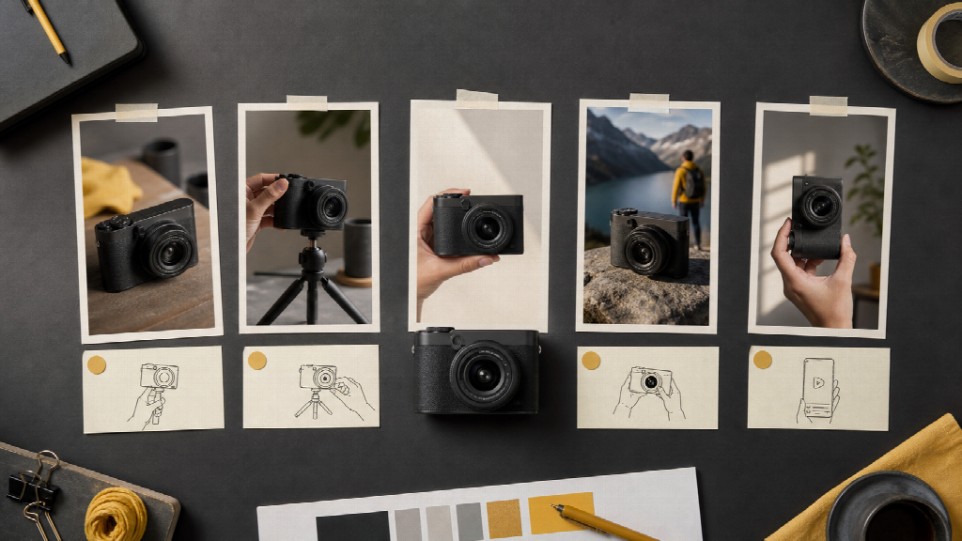
The most expensive part of short-form production is often not the camera day. It is repeatedly deciding what to make. Teams create a product demo, then start over for a tutorial, a paid ad, a product-page clip, and a social post. A content system solves that by treating every approved shot as a reusable component. Wan 3.0 AI can support the system when generation begins from roles and references rather than isolated prompts.
Think in modules before thinking in posts
A post is a finished arrangement. A module is a piece that can serve several arrangements. For one product, the core library might include:
- a clean reveal;
- a problem or context shot;
- a close detail;
- a credible demonstration;
- a result or use moment;
- a neutral product ending;
- an offer-ready ending with space for current copy.
These modules can become a tutorial, a paid hook test, a product-page explainer, or a quiet organic clip. Planning this way reduces the pressure on every generation to produce a complete masterpiece.
Give every reference a permanent role
Alibaba describes Wan 3.0 as an all-in-one model with multimodal reference, native audio, editing, and extension capabilities. A repeatable content system can assign stable inputs:
- pack shots protect product identity;
- a motion reference defines camera behavior;
- the brand guide sets color and restraint;
- the product page supplies approved facts;
- a campaign brief defines the message for this batch.
When these roles remain consistent, the team can change one instruction without rewriting the entire creative context.
Build five format families
Most commerce teams can begin with five useful families:
- Demonstration: show one function clearly.
- Tutorial: explain a short sequence of use.
- Detail story: focus on material, construction, or design.
- Lifestyle context: show where the product belongs.
- Offer cut: combine proven product footage with current commercial copy.
Each family needs its own pacing and proof. A tutorial cannot be cut like a mood film, and an offer cut should not hide the product behind atmosphere.
Use longer generation as source material
Wan 3.0 supports up to 30 seconds per generation in Alibaba’s documented implementation. That can be useful for creating a coherent source sequence with movement and audio. The editor can then extract a six-second reveal, a 15-second social cut, and a longer product explainer.
The maximum is a production option, not a publishing target. Generate enough continuity to create choices, then let the destination determine the final length.
Preserve a product continuity spine
Across every family, lock the physical details that matter: dimensions, color, texture, controls, labels, accessories, and behavior. Review generated modules next to one another as well as against the source. A shot can look accurate in isolation and still reveal obvious drift when placed after another.
The continuity spine is what allows Wan 3 to contribute scale without fragmenting the brand. If the product cannot remain reliable, use real footage for that module and reserve generation for the surrounding scene.
Create an editorial inventory
Store more than filenames. Record the module type, product version, orientation, duration, approved claims, audio status, expiration date for offers, and platforms where it is cleared. Editors can then find “neutral ending, vertical, no offer” instead of opening twelve exports.
This operational layer is what turns a set of clips into a content system.
Establish a rule for regeneration
Regenerate when a module is inaccurate, missing, or unable to support a real format need. Do not regenerate merely because a new visual is easy to request. Constant replacement makes the library harder to understand and can introduce fresh product drift.
When a module underperforms, first ask whether the problem is the message, placement, pacing, or proof. A new generation helps only when it addresses the diagnosis. This keeps the system from confusing activity with improvement.
FAQ
How many modules does one product need?
Start with the smallest set that covers your recurring formats. Six or seven strong modules are more useful than dozens of near-duplicates with unclear roles.
Should every module be AI-generated?
No. Use real footage wherever physical accuracy, human trust, or detailed operation matters. Mix it with generated material when the transition is honest and visually coherent.
How often should the system be refreshed?
Refresh when customer questions, the product, the offer, the platform, or performance evidence changes. Do not regenerate only because a calendar month has passed.
Conclusion
Wan 3.0 becomes more useful when a brand stops asking for one-off videos and starts building reusable modules. Define format families, protect a product continuity spine, and maintain an editorial inventory so every new generation has a clear place in the system.