
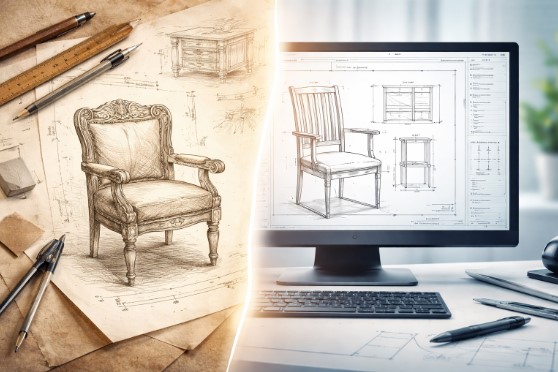
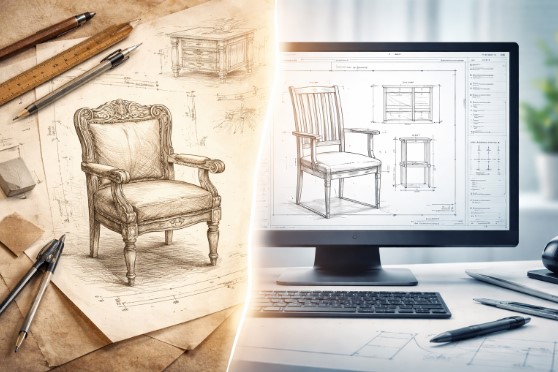
Furniture design has always existed at the intersection of creativity, craftsmanship, and precision. While the finished product often captures attention, it is the documentation behind the scenes that makes reliable production possible. Furniture documentation acts as the common language connecting designers, manufacturers, engineers, and installers—ensuring that a concept moves seamlessly from idea to physical object.
Over time, the methods used to document furniture designs have evolved dramatically. What began as hand-drawn sketches created by skilled artisans has transformed into standardized, highly accurate digital outputs. At the heart of this evolution lies Furniture 2D Drawing, a format that remains foundational even in today’s advanced digital design environments.
This article explores how furniture documentation has progressed—from handcrafted sketches to precise technical drawings—and why 2D drafting continues to play a critical role in modern furniture design and manufacturing.
Early Days: Hand Sketches and Craftsmanship
Before the advent of formal drafting standards or digital tools, furniture documentation relied almost entirely on the designer’s hand and experience. Master craftsmen sketched ideas directly onto paper or workshop surfaces, often relying on proportions learned through years of practice rather than fixed measurements.
These sketches were expressive and intuitive. They allowed artisans to communicate style, form, and ornamentation with remarkable clarity. In many cases, the same individual designed, built, and refined the furniture piece, minimizing the need for detailed instructions.
However, hand-drawn documentation had clear limitations. Measurements were often approximate, variations were common, and reproducing identical pieces at scale was challenging. As furniture production moved beyond one-off pieces toward larger batches, the need for more precise and repeatable documentation became unavoidable.
Transition to Technical Drafting
The industrialization of furniture manufacturing marked a turning point in documentation practices. Workshops and factories needed drawings that could be understood consistently by multiple workers across different stages of production. This led to the adoption of technical drafting methods that emphasized accuracy, scale, and standardization.
Furniture drafting evolved to include orthographic views—plans, elevations, and sections—along with detailed dimensions and annotations. These technical furniture drawings reduced ambiguity and allowed manufacturers to replicate designs reliably. Standard measurement systems, tolerances, and material specifications became integral parts of documentation.
This period laid the groundwork for professional furniture documentation as we know it today. Drawings were no longer just conceptual tools; they became contractual and manufacturing references that defined how a product would be built.
Rise of Furniture 2D Drawing in the Digital Age
The introduction of computer-aided design (CAD) tools revolutionized furniture documentation. Digital drafting replaced manual techniques, offering unprecedented precision and efficiency. Designers could now create, edit, and replicate drawings with ease, dramatically reducing production errors.
Furniture 2D Drawing became a central deliverable in digital workflows. CAD-based drawings allowed designers to define exact dimensions, align components accurately, and maintain consistency across multiple views. Layers, annotations, and standardized templates further improved clarity and collaboration.
Despite the rise of 3D modeling, 2D drawings remain essential. Manufacturers still rely on flat, dimensioned drawings for cutting lists, machining, and quality control. A well-executed Furniture 2D Drawing communicates intent clearly, without the interpretation challenges that complex models can sometimes introduce.
In many production environments, 2D drawings serve as the authoritative reference, even when 3D models are available.
Why 2D Drawings Remain Essential Despite 3D Modeling
While 3D visualization tools have transformed design presentation and client communication, they have not replaced technical documentation. Instead, they complement it.
2D drawings excel at communicating precise measurements, tolerances, and relationships between components. Machinists, fabricators, and installers often prefer technical furniture drawings because they provide immediate access to critical information without the need for specialized viewing software.
Additionally, Furniture 2D Drawing files are lightweight, easy to archive, and universally compatible across design and manufacturing platforms. They support faster approvals, clearer markups, and more efficient revisions—especially in large-scale or distributed production environments.
Rather than becoming obsolete, 2D drafting has evolved into a refined, highly specialized discipline within modern furniture design.
Precision, Manufacturing, and Global Collaboration
As furniture manufacturing has become increasingly global, documentation precision has taken on even greater importance. Designs are often created in one location, manufactured in another, and assembled elsewhere. Clear, accurate drawings are the only way to maintain consistency across these distances.
Precise furniture drafting minimizes misinterpretation, reduces rework, and improves production efficiency. Manufacturers can optimize material usage, streamline machining processes, and maintain tighter quality control when working from accurate CAD furniture drawings.
Cost savings are another significant benefit. Fewer errors mean less wasted material and time. When Furniture 2D Drawing files are well-structured, they enable faster prototyping, smoother approvals, and more predictable production timelines.
In an industry where margins are often tight, high-quality documentation directly impacts profitability.
Modern Trends in Furniture Documentation
Today’s furniture documentation workflows are increasingly integrated and hybrid. Designers often use a combination of 2D drawings and 3D models, each serving a specific purpose. While 3D models support visualization, ergonomics, and client presentations, 2D drawings remain the backbone of manufacturing documentation.
Integration with CNC machining has further elevated the importance of precision drafting. Technical furniture drawings now feed directly into digital fabrication systems, ensuring that what is designed is exactly what gets produced. In architectural contexts, furniture documentation is also aligning with BIM workflows, allowing furniture to be coordinated alongside building elements.
Cloud-based collaboration tools, standardized libraries, and automated dimensioning are shaping the future of furniture drafting. Yet, the core principles—clarity, accuracy, and consistency—remain unchanged.
Conclusion
The evolution of furniture documentation tells a broader story about the design industry itself: a continuous pursuit of precision without sacrificing creativity. From expressive hand sketches to standardized technical drafting and advanced digital tools, each stage has built upon the last.
Despite rapid technological advancements, Furniture 2D Drawing continues to play a vital role in furniture design and manufacturing. Its ability to communicate exact intent, support efficient production, and bridge disciplines ensures its relevance well into the future.
As digital workflows become more sophisticated, the most successful professionals will be those who understand not just how to model furniture—but how to document it clearly, accurately, and intelligently. In that sense, the evolution of furniture documentation is far from complete; it is simply entering its next, more connected chapter.